
Notes on TRAY/01
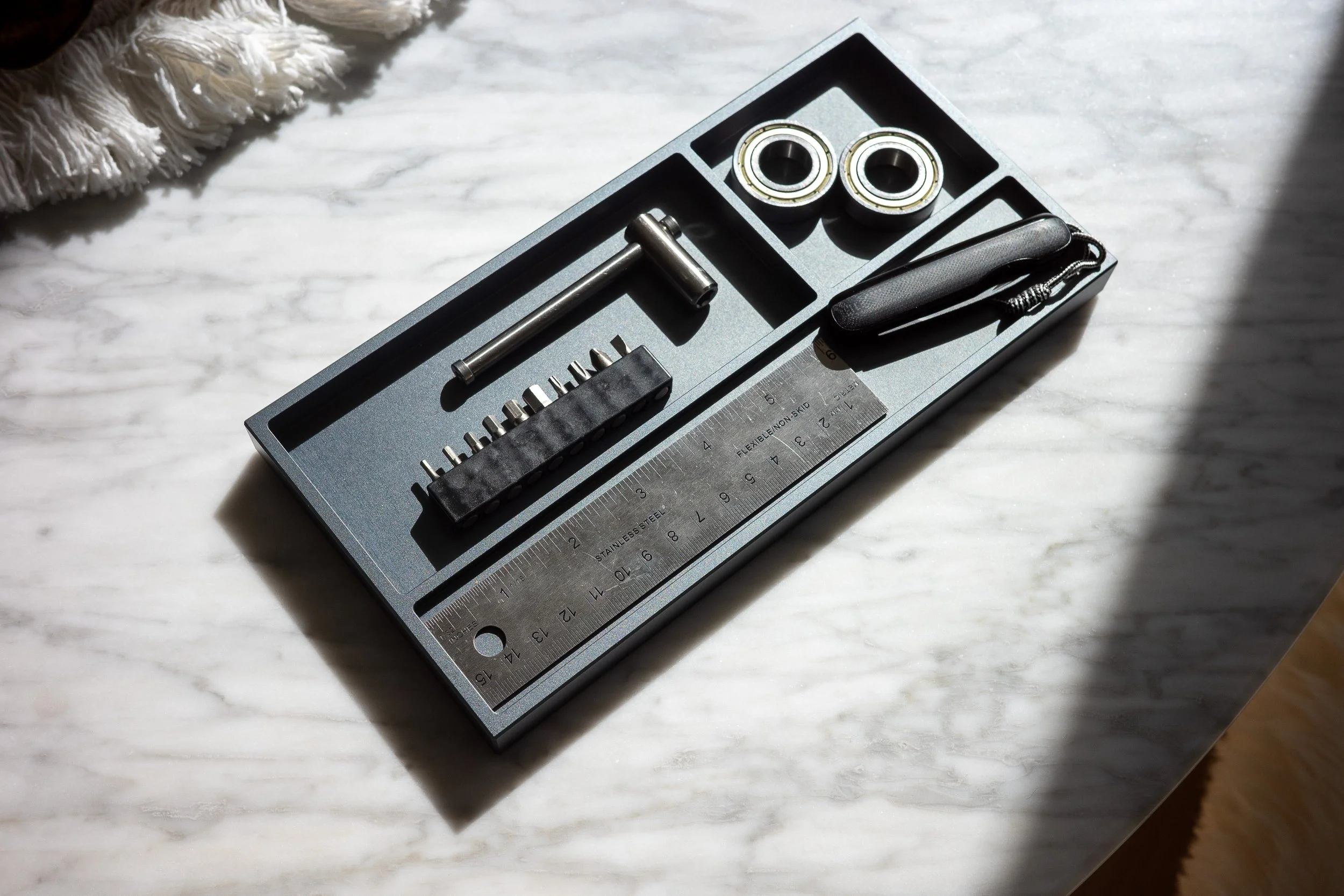
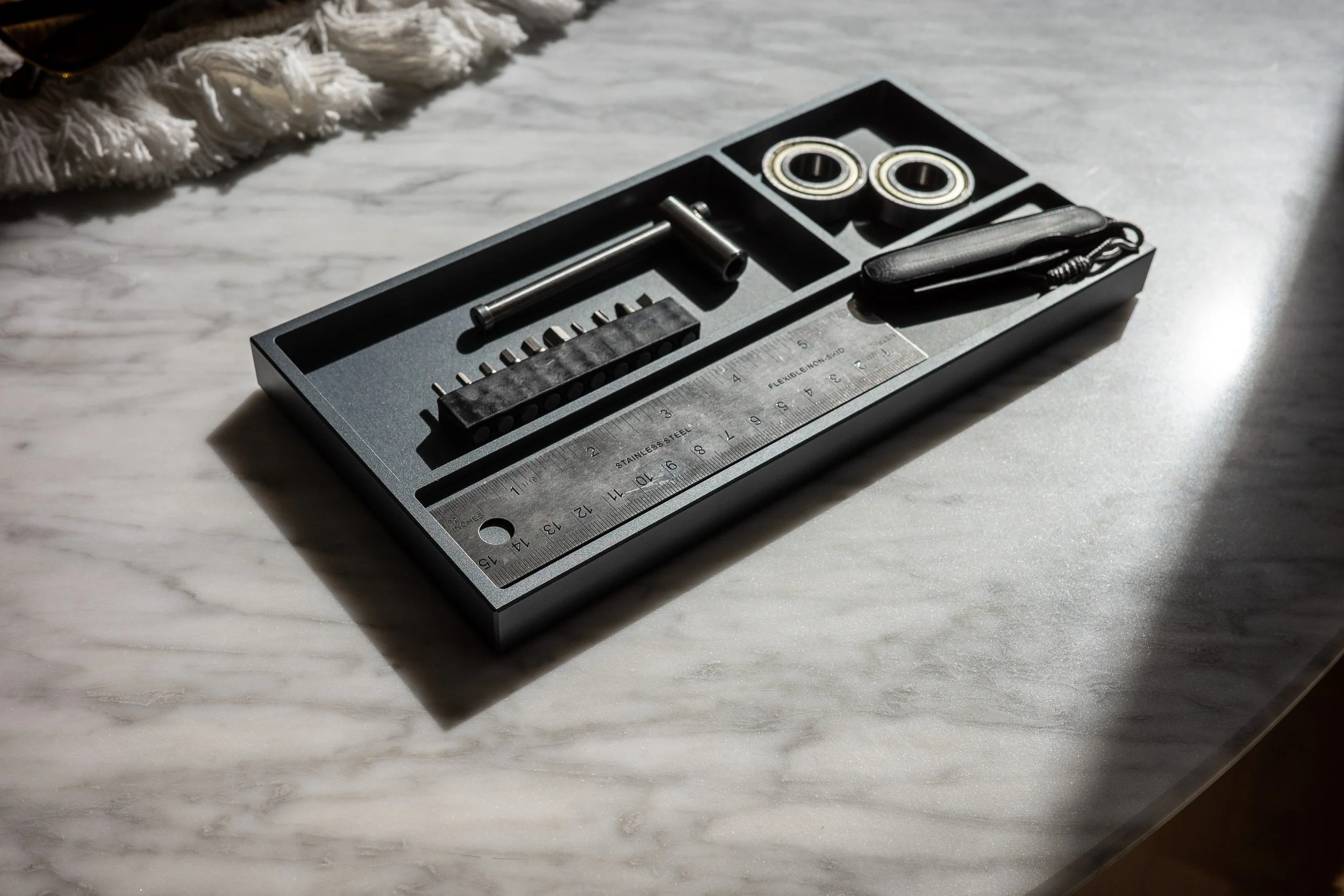
TRAY/01 is the first product released under Common Tol. It's a CNC-machined aluminum desk tray, Type II anodized, designed to hold the things that accumulate near a workspace: keys, glasses, a pen, a pocket knife, whatever the day deposits. The form is rectangular and the geometry is unornamented, but most of the decisions inside that geometry are deliberate. A few worth noting:
Wall thicknesses
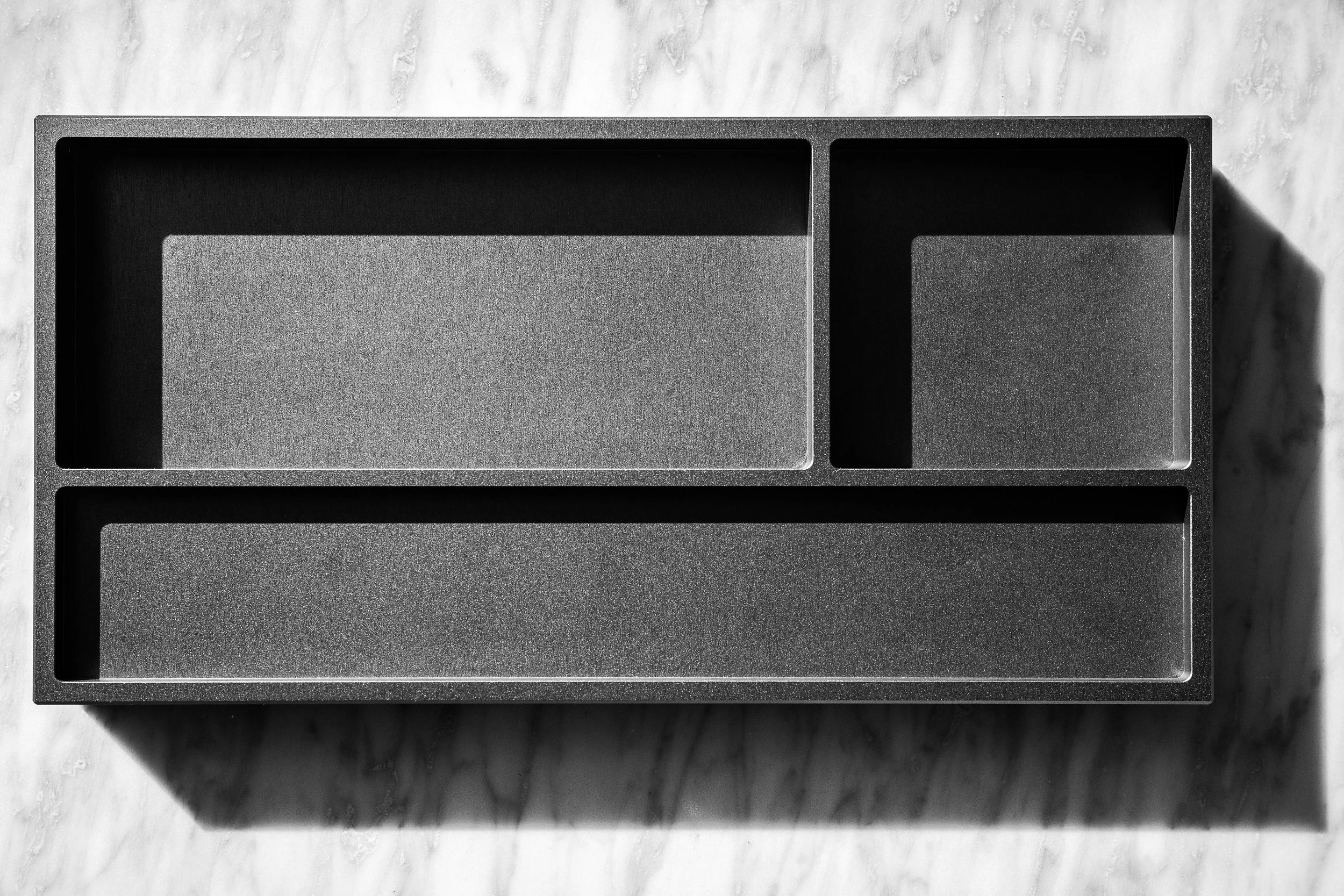
The exterior walls are 5mm. The interior walls between compartments are 4mm. The difference is small but it shifts how the tray reads. The exterior is the perceived edge of the object, what your hand contacts when you lift it, what your eye registers when you set something near it, so it carries more substance. The interior walls only need to separate compartments, so they can be thinner without compromising rigidity. Mass concentrated where mass is felt.
The raised pen pocket
The pen pocket sits 7mm above the floor of the other compartments. Two reasons.
Ergonomically, a pen lying flat in a deep pocket is awkward to retrieve — your fingers have to clear the wall before you can lift it. Raising the floor brings the pen up to a height where it can be picked up cleanly with a pinch.
Structurally, the extra material adds mass to a specific location on the tray, which makes it sit more firmly on a desk and gives the object a subtle internal architecture rather than a single flat plane. The raise is a feature you can see when you look down at the tray and feel when you pick it up.
Machined chamfers, not broken edges
Most machined parts have their edges "broken" — a light pass that removes the sharpness left by the cutter. It's the minimum required to make a part safe to handle, and the result varies depending on who deburred it and how carefully.
TRAY/01's edges are chamfered. Every chamfer is a specific dimension called out on the drawing and programmed into the toolpath. Every edge gets the same treatment. Every chamfer reads identical, both visually and in the hand. A chamfer is something you specify. A broken edge is something you accept.
Surface and finish
After machining, the tray is sand blasted. This isn't strictly necessary — the part would anodize without it — but blasting produces a uniform matte texture that removes residual tool marks and gives the anodize an even, saturated color across the whole surface.
The finish itself is Type II, the durable variant used in aerospace and industrial applications. It penetrates the aluminum surface rather than coating it, which means the color and the wear resistance are integral to the part rather than applied on top.
Closing
None of these decisions are visible at a glance. The tray reads as a clean rectangular object with compartments inside it. But the difference between a part that's been designed and a part that's been quickly drawn is in exactly these kinds of small specifications — wall thicknesses, raise heights, chamfer dimensions, surface prep. TRAY/01 is the result of caring about them.
Why Edges Matter
Most objects are understood first by outline, then by surface, and finally by detail. Edges sit between all three.
They define the form. They catch light. They shape how an object is handled, how it wears, and how precise it feels in use.
On a machined object, edges are rarely incidental. A sharp edge can feel abrupt or unfinished. A heavily rounded one can soften the geometry too much and make the object feel less exact. The right edge does something quieter: it resolves the transition between surfaces without calling too much attention to itself.
That matters both visually and physically.
A clean chamfer changes how light moves across a part. It gives planes a clearer boundary. It makes proportions read more deliberately. In the hand, it removes the harshness of a raw corner without erasing the form.
Edges also reveal discipline. They show whether a part was merely produced or actually considered. How they break, how they meet, how consistently they carry through a piece—these are small decisions, but they are often what separate a resolved object from one that only looks acceptable at a distance.
For COMMON TOL., edges are not decoration. They are part of the function of the form. They affect touch, durability, legibility, and the overall sense that an object has been finished properly.
That is why they matter.
Not because they ask to be noticed, but because the object feels different when they are right.
Type II Anodizing
Type II Anodizing
Aluminum is useful in its raw state, but unfinished metal rarely stays that way for long. It marks easily, shifts in appearance with use, and can feel incomplete.
Type II anodizing resolves that.
It is an electrochemical process that builds a controlled oxide layer on the surface of the aluminum. Not a coating laid over the part, but a finish grown from the material itself. The result is better corrosion resistance, a more durable surface, and a more deliberate final appearance.
For machined objects, that matters.
A well-made aluminum part already has the right things to say: mass, edge definition, flatness, proportion. The finish should support those qualities, not bury them. Type II anodizing does that well. It keeps the material legible while giving it more protection and a more uniform surface.
It is also honest. It does not disguise poor geometry or careless machining. If anything, it asks more of the part underneath. Surface prep, edge quality, and toolpath discipline all remain visible in the final result.
That is part of the appeal.
For COMMON TOL., Type II anodizing fits the same logic as the objects themselves: durable, restrained, and precise without calling attention to the process for its own sake. It lets aluminum remain aluminum, just more resolved.
Not decorative. Not excessive. Just finished properly.
Aluminum is useful in its raw state, but unfinished metal rarely stays that way for long. It marks easily, shifts in appearance with use, and can feel incomplete.
Type II anodizing resolves that.
It is an electrochemical process that builds a controlled oxide layer on the surface of the aluminum. Not a coating laid over the part, but a finish grown from the material itself. The result is better corrosion resistance, a more durable surface, and a more deliberate final appearance.
For machined objects, that matters.
A well-made aluminum part already has the right things to say: mass, edge definition, flatness, proportion. The finish should support those qualities, not bury them. Type II anodizing does that well. It keeps the material legible while giving it more protection and a more uniform surface.
It is also honest. It does not disguise poor geometry or careless machining. If anything, it asks more of the part underneath. Surface prep, edge quality, and toolpath discipline all remain visible in the final result.
That is part of the appeal.
For COMMON TOL., Type II anodizing fits the same logic as the objects themselves: durable, restrained, and precise without calling attention to the process for its own sake. It lets aluminum remain aluminum, just more resolved.
Not decorative. Not excessive. Just finished properly.